The Himalayas have temperatures ranging from plus 10 to minus 40 degrees Celsius ❄️. Cold weather photography at this altitude, particularly in extremely cold weather, can be difficult. When it's that cold, photography, and just about everything else, becomes tenfold more difficult. However, the icy, snowy, white winter wonderland-like images are well worth it. Here are some of my recommendations for cold weather photography, based on my time in the Himalayas and several travels to Kashmir, Uttarakhand, Sikkim, and other Himalayan mountainous locations.
Snowfall at 12,451 feet Tarsar Lake, Jammu and Kashmir, India
Cold weather photography essentials
?Battery and its Performance
The performance of batteries is hindered by extremely cold conditions. Extras batteries should be kept in a warm pocket close to your body. For my full-frame DSLR camera, I normally take four camera batteries, which will last for a week if properly packed and stowed.
According to my cold weather photography experience, at approximately 0 degrees Celsius at the camping and sub-zero at night, the battery depleted by roughly 17 percent in all the unused batteries after 3-4 days. So, to retain the charge, I store my batteries in a plastic zip locker and I keep them in a warm location, such as the inner pocket of my down jacket.
Also, remember to carry extra batteries and power banks for smaller gadgets like GoPro or DJI Action camera. Most of the action cameras have a Type C charger and power banks can easily support this A power bank with 20,000 mAh and above is recommended.
Mystery Skeletal lake, Roopkund at 14,882 feet in the Himalayas, Uttarakhand, India
?Use of Filters
Snow white can cause blindness, hence sunglasses are usually recommended. The same is the case with the camera, and you'll need filters. However, don't underexpose the shot; else, the snow will seem grey. If you're interested in long exposure photography, cold weather photography might be tricky. On the white section of the histogram, the snow-white might blow up. As a result, it's a good idea to use ND filters and set the stops dependent on the intensity of the light. Recovering from whites in the histogram can be challenging if the image is over-exposed.
?Water-resistant backpack
A water-resistant backpack for cold weather photography is a must. In addition to having a water-resistant cover for your DSLR, it is highly advised to have a rain/snow cover. The Lowepro backpack that I have comes with an attached rain cover in it. Else you can always buy additional coverage based on the volume of your bag. Again, this cover is useful for light showers but now for heavy rain or snow. It is better to take shelter in a proper place, maybe in a tent if you are in the wild.
That's me experimenting with Cold Weather Photography at Hampta Pass at 14,009 feet, Himachal Pradesh, India
?Carbon Fiber Tripod
Having metallic tripod arms can make it hard to hold while in cold weather photography. A rubber coating on top of the metal or a carbon fiber tripod leg can be super helpful as it is a bad conductor of heat or cold. From basic rubber-coated flexible tripods to high-end carbon fiber tripods, there are many that you can buy based on your budget. Note that carbon fiber tripod is expensive and lightweight. It is ideal if you are into cold weather photography up in the mountains when you are on a hike for a few days, for example, while hiking in the Himalayas.
?Personal Apparel
When you are considering cold weather photography, it is important to consider your personal clothing too. For example, in addition to regular clothing, there are other things to keep in mind. For example, the thermals, windshield jacket, down feather jacket, cold weather hiking shoes, woolen cap, and most importantly, the hand glows which has optional openings. So that it is easy to operate your camera if it has touch screen options.
The fixed tent and the layer of snow underneath at Bagwabasa campsite, Roopkund.
These points that are mentioned above are based on my personal trekking experience in the Himalayan snow-clad mountains. I go for weeklong trekking in the Himalayas every year and cold bad weather is always a concern. Cold weather photography can be super challenging, and I usually avoid winters as it is extremely hard to hike to the destination and the trail remains closed.
You might want to check my outdoor activities where I have discussed in detail all my previous treks. Also, consider subscribing to my Youtube channel or you can even buy me a coffee to support my work.
Bhutan is a culturally and ecologically distinct country. It is the planet's last remaining Buddhist kingdom, perched high in the Himalayas. It has established the Gross National Happiness ideology, in which development is assessed using a comprehensive approach to well-being rather than merely GDP. Tourism, hydroelectric power, and agriculture are the kingdom's main sources of revenue. Well, there are many places to visit in Bhutan, but if you are on a budget trip and have just a few days to spare then here are the top 10 places to visit in Bhutan.
To start your journey, you may directly fly to Paro which might be expensive, or fly to Bagdogra in India and drive to Bhutan. The drive here is scenic as you cross the tea gardens and mountains all around. In the north of West Bengal, there is a diversion to the right which will take you to Bhutan where you need to cross the Teesta river.
The other route will take you to Gangtok, Sikkim which is another beautiful place. Stay overnight once you cross the border at Phuentsholing. On the next day get a visa on arrival and pay the fees to proceed further. You may find the latest updated details here.
By the way, you might want to check the best camera travel gear that I use to travel light and be safe. Also, you might want to get this complete guide with in-depth details on everything you need to know and cover all the places when you plan to travel to Bhutan.
Here goes the list of top 10 places to visit in Bhutan
Phuentsholing
? Phuentsholing, the doorway to the country of thunder dragons, is frequently referred to be the Himalayan Kingdom's residence of kings and queens. Moreover, time flows slowly here, and the residents' simplicity fits the natural tranquility. In addition, at barely 300 meters above sea level, this Bhutanese commercial hub is located next to the Indian town of Jaigaon in the foothills of the Himalayas. In Phuentsholing, there are several sites to visit where you can see the richness of Bhutanese, Nepalese, and Indian cultures. After that, the next stop from Phuentsholing is Paro.
https://youtu.be/kL_wbvBNj_M
Tiger's Nest
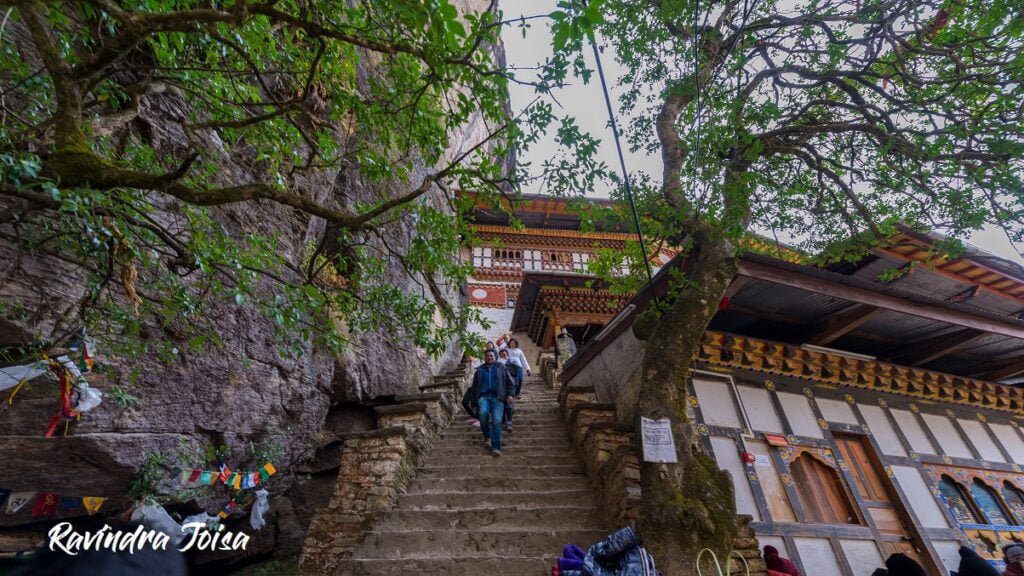
?The Paro Taktsang Monastery (Tiger’s Nest Monastery), nestled high in the Himalaya Mountains, is one of Bhutan's most prominent cultural and religious landmarks. This video provides a summary of the hiking trail, what to expect, as well as architectural details of the monastery. It is a 2 to 3 hours of a hike uphill with some beautiful views. This hike is ideal for those who don't want to go for a week-long hike but interested in a short day hike. If you are considering any hike then this is one of the best places to visit in Bhutan, to start with.
https://youtu.be/EvVTGjyqVr0
National Memorial Chorten
☮️ This huge chorten is one of Thimphu's most obvious monuments, and it is the center of daily devotion for many Bhutanese. The whitewashed chorten, with its sun-catching golden finial, has complex mandalas, sculptures, and a shrine dedicated to the popular king, as well as elaborately painted annexes facing the cardinal directions.
Places to visit in Bhutan should include the National Memorial Chorten as the approach to this is in the middle of Thimphu town. The action lasts from early morning until late at night, although visitors are forbidden from attending at night to give devotees a break. Keep an eye on the devoted group of elderly timers who are churning away at room-size enormous prayer wheels beside the main entrance.
Thangka Painting and Art Gallery
?The traditional art of painting the life of Buddha on fabric or silk appliqué is known as Thangka. The origins of the Thangka painting may be traced back to Tibetan Buddhist art. These works were created in Bhutan, Nepal, Tibet, and India. The 'mandala' is seen in Thangka paintings composed of cotton, silk, and human skin (Mandala in Sanskrit means is a spiritual and ritual symbol representing the universe). The life of Buddha is commonly depicted in Thangka paintings. This gallery is not just one of the places to visit in Bhutan but an ideal place to purchase authentic artwork.
A person must train for years to become a thangka artist, and the paintings are extremely uncommon and costly, with prices reaching into the thousands of dollars - sample painting and my complete collection mainly used for home decor. These thangkas are composed of natural color stone crushed plant leaves and roots, as well as 24k gold dust. Your places to visit in Bhutan bucket list must include a visit to this art gallery which is located in Thimphu.
https://youtu.be/wicAdpMcENw
Buddha Dordenma
? World’s largest mountaintop statue of Buddha Dordenma is located in the western parts of Bhutan, Thimphu. A must-visit place if you are in Thimphu. The huge structure of Buddha (Shakyamuni) is made of bronze and is gilded in gold. The view from here is breathtaking as it overlooks the southern entrance to Thimphu valley. This huge structure of Buddha is a new addition to this historical place and is now one of the top places to visit in Bhutan.
? The National Memorial, Dochu La, or Dochu Pass, is at the pass's center peak with 108 stupas or Chortens. It's midway between Thimphu and Punakha, Bhutan, and offers breathtaking views of the Himalayan mountain range. Dochula Pass is around 3100 meters high, and the area is still hazy. The weather at Dochula Pass is beautiful and clear around December, allowing you to see the Himalayan mountain range.
https://youtu.be/5_l3ecLzsII
Chimi Lhakhang - Fertility Temple
⛩️ There is one less known and unique monastery by the name Chimi Lhakhang, with a lot of 'penises' around. Yeah, you heard that right. Chimi Lhakhang, located in the Punakha requires district-level permission. In addition, Chimi Lhakhang is on the way to Punakha Dzong. It is just over 100 kilometers from Paro and 65 kilometers from Thimphu. Meanwhile, reaching the Chimi Lhakhang monastery from the highway is an approx one-kilometer hike. Above all, the hike is scenic, crossing the paddy fields, via the Yowakha village full of handicraft stores, paintings, and prayer flags. Also, the hike can be even more picturesque if you take the back entrance, next to the Puna Tsang Chu river.
https://youtu.be/upoqSUIXGyo
Punakha Dzong
? Punakha Dzong – meaning ‘great pleasure’ or ‘joy castle’, is the administrative headquarters of Punakha. Also, it is the second oldest and second-largest dzong in Bhutan, and one of its most beautiful buildings. Moreover, Punakha Dzong served as the administrative headquarters until 1955. Above all, the Punakha valley, the location of Dzong is in between the Pho Chhu (male) and Mo Chhu (female) rivers. Punakha is Bhutan’s winter capital. Punakha Dzong tops the places to visit in Bhutan.
https://youtu.be/uhqiYPu6Q2M
In addition to Punakha Dzong, there are many Dzongs at different places to visit in Bhutan. The one in Thimphu is spectacular, especially late in the evening when all the lamps are illuminated one by one. Most of the Dzongs are lit up and look amazing and a perfect place for nighttime architecture photography.
Punakha Suspension Bridge
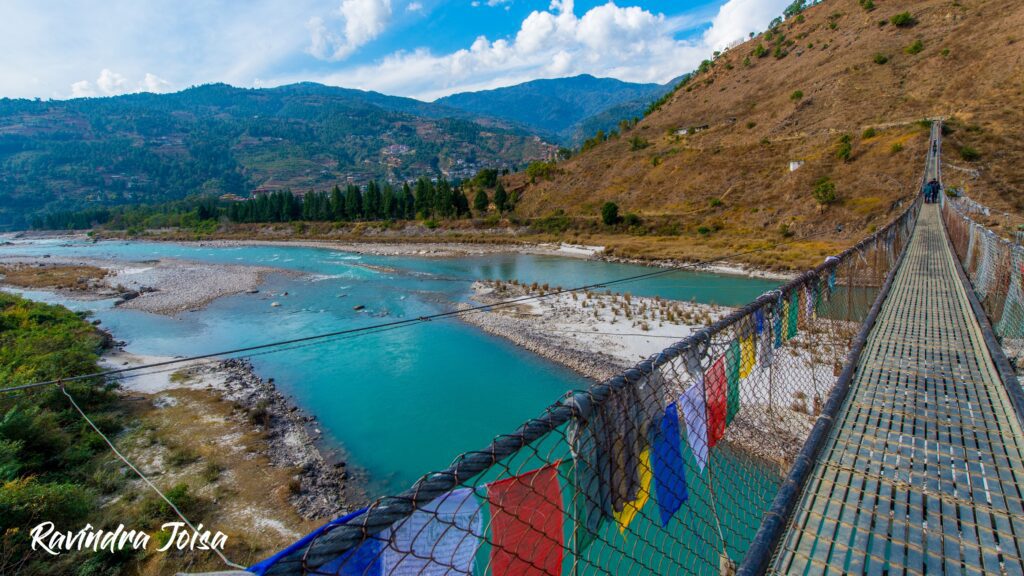
? Suspension bridges are ideal for Bhutan’s high mountains and deep valleys. Punakha Suspension Bridge is a wonderful illustration of this, for the decoration of colorful prayer flags. This is one of Bhutan’s longest suspension bridges. In addition, it connects Punakha Dzong to Shengana, Samdingkha, and Wangkha villages across the Po Chu river, which is usually not listed in the places to visit in Bhutan. It is, nevertheless, astonishingly stable for a 520-foot-long suspension bridge. Moreover, the east side of the river is an excellent starting place for multi-day hikes in the surrounding mountains. Also, the bridge provides a beautiful view of the river and valley.
https://youtu.be/Fc0by-do5Dg
Punakha Campsite
⛺ Camping in Punakha along the banks of the Mo Chu River is a dream come true. Firstly, the golden dunes and flowing water create such a stunning scene that will make you speechless. Secondly, around the river are tiny establishments where you may spend time with the locals. You may also witness the perfect Bhutanese architecture at Punakha Dzong in the twilight. The campsite at Punakha is one of the top places to visit in Bhutan known for its beautiful misty mornings that appears truly magical, next to the river.
https://youtu.be/m-R1E_-EBZ4
Places other than these top 10 places to visit in Bhutan
So, these are the top 10 places to visit in Bhutan. Other places include the Ha valley that stretches along the Haachu river in west Bhutan. In addition, you may want to cover the Dzong present in Paro and Thimphu, and do not forget to see the lighting late in the evening. Also, visit the old traditional paper mill which is right next to Thangka Painting and Art Gallery.
When visiting some of the locations, please be considerate. Unbeknownst to them, outsiders may pay a visit. For example, the clothing code for entering the monastery, the use of a camera. It is important to consult while visiting places in Bhutan with your local guide.
In conclusion, for those who want to experience the true Buddhist culture and heritage then this is the place to visit. For more info and places to visit in Bhutan, you may want to buy this book by Lonely Planet Bhutan where you will find the details on the local festivals, hotels, restaurants, and many more. Also, it has more details on For those who have time these if you are on a budget trip and have just a few days to spare then here are the top 10 places to visit in Bhutan is just the tip of the iceberg. And finally, support my work by Subscribing to my YouTube channel and joining my FriendZone for more.
I've spent a lot of time in the Himalayas, including my most recent job assignment - workation ?, traveling ✈️, and mountaineering ⛰️. And I have always been experimenting with different camera gear in search of the essential travel camera gear. One thing to keep in mind when traveling is to pack as little as possible with all of the essential things. The high-end, cumbersome camera should only be utilized for highly professional assignments; otherwise, travel camera gear should be kept light.
My essential travel camera gear mostly consists of tiny, portable, convenient, easy-to-carry gear with less interchangeable lenses, flexible tripod, etc., as well as various batteries, power banks, and filters for photography mainly used in stock websites and videos for my YouTube channel. The essential travel camera gear mentioned below is ideal for your personal use, or for creating content online like YouTube or for a blog post of this kind.
https://youtu.be/u7oIqM5vOgc
Here goes the list of Essential Travel Camera Gear
⚙️ DJI Pocket - 3-Axis Gimbal Stabilizer with 4K Camera: An ideal 4k camera that fits in your pocket without the trouble of lugging along a hefty camera or gimbal. The gear has a high-quality microphone. I've been using this for a lot of my previous Vlogs. However, don't forget to use the wide-angle lens so your face doesn't seem too close or sliced. This is one camera that will easily fit into even your jeans pocket.
https://youtu.be/qAhQQKlZBJQ
⚙️ DJI Mini Fly More Combo: This is a nano drone that is just below 250g made specifically keeping in mind the government regulations in flying drones. Travel safe and free with no worry of any license or approval of any kind needed for this nano drone. Something that will easily fit in your bag.
A great entry-level drone with more features and better performance. That includes a much stronger signal for stress-free flying. Note that if you are completely new to drones, this is an excellent drone to fly since if you do not know how to control it properly, you may experience troubles such as drone flyaway, ?well, that was my experience and I almost lost it.
⚙️ DJI OM Smartphone Gimbal Stabilizer: If you're into mobile filmmaking and are happy with your camera phone but want to add video stabilization, this is the device for you. It is somewhat more expensive than other gimbals. Its connection with the DJI Mimo app gives it a level of capability that no other gimbal has. If you make YouTube Shorts, Reels, or TikTok videos, this is the tool for you.
https://youtu.be/8-PbzeL2y94
⚙️ DJI Action Dual Screen Combo: In your travel luggage, the ultra-compact DJI Action takes up next to no space. The revolutionary magnetic design of the Action lets you easily swap out attachments while capturing life on the go. Record ultra-smooth 4K/120fps footage with more clarity than ever before. The DJI Action camera is built to last and is waterproof straight out of the box. So, you can document your aquatic activities. ??♂️
https://youtu.be/9tV4R_1n7Tw
Other essential travel camera gear
In addition to the essential travel camera gear that I have mentioned above, there are a few important gadgets to consider that are super essential. You'll also needpower banks to charge the batteries, micro SDXC cards, quick chargers, extremely portable SSD storage, and a Micro SDXC Card reader OTG. In addition, the camera bag is the most crucial item to bring. A good camera bag is a must, as these camera gears are compact. ?
So, these are some of the essential travel camera gear that you definitely need to have. All these gadgets are based on my own experience. After using them extensively for multiple weeklong travel and trekking expeditions in the extreme cold Himalayan weather ?. Hope you find this useful. Also, check out more on the gadgets that I use on my YouTube channel and support my work by subscribing ▶️. You may signup for my fortnightly newsletter by joining my Friend Zone. ? Note that I keep updating my essential travel camera gear whenever there is a new gadget available and if I find it super useful. The latest will be updated in the kit link.
The Paro Taktsang Monastery (Tiger's Nest Monastery) was established on the site of a cave set into the cliff in the late 16th century, perched nearly 3,000 meters above the Paro valley. Although we refer to it as the "Tiger's Nest" in English, Taktsang really means "tigress' lair" and is named after the narrative surrounding its establishment.
Tiger's Nest - Incredible cultural monument
The history
Guru Rinpoche, a 7th-century Indian Buddhist leader, was said to have been carried up the mountain on the back of a devotee who had changed herself into a tigress, according to mythology in order to subdue evil demons residing within it. Guru Rinpoche meditated in the cave for 3 years, 3 months, 3 days, and 3 hours after they arrived. Since then, the cave has been revered as a sacred spot, and many great saints have visited there to contemplate. Hence the name Paro Taktsang as it is a sacred site.
Paro Taktsang Monastery
When to go and what to expect
We got up early and left Paro about 7 a.m. to reach the foot of the mountain around 8 a.m., when the site opens to the public, to allow us the most time possible to complete the Tiger's Nest walk. There is a modest collection of stalls, set up at the entrance to sell souvenirs and crafts. Visit these stalls while you return. Also, you get wooden hiking sticks for rent which can be helpful as you will have to hike uphill.
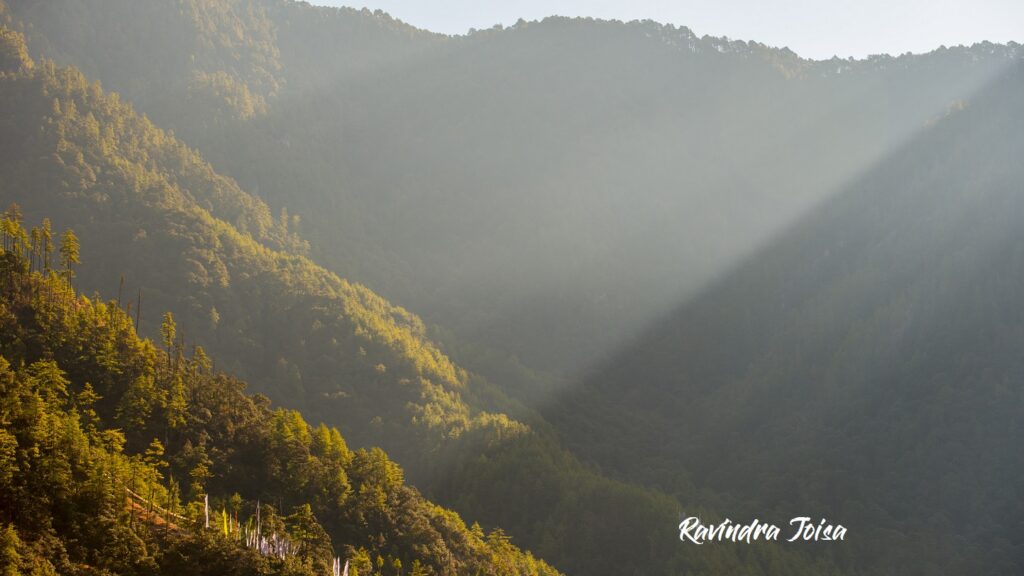
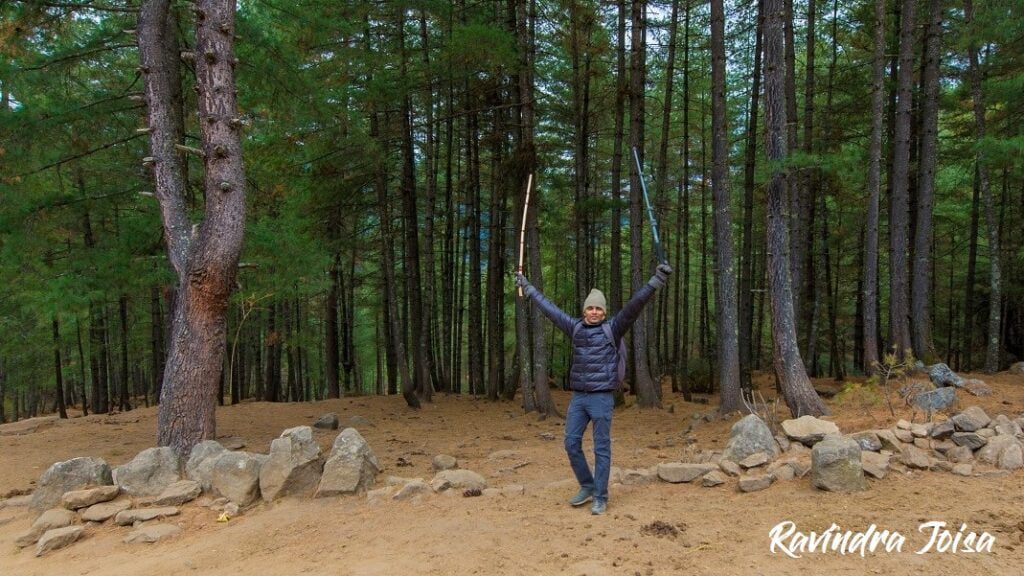
Tiger's Nest hike in the pine forest
The hike to Tiger's Nest begins here
The stroll begins slowly once you've passed the booths. We traveled a few fields up to the cliff's base after passing through the gate. Locals keep mules and horses here, which you may hire to help you ascend the trail. We entered the woodland region that runs along the cliff's edge. The trail begins to zig-zag through the trees as the slope becomes steeper, making the ascent easier.
The hike to Tiger's Nest begins here
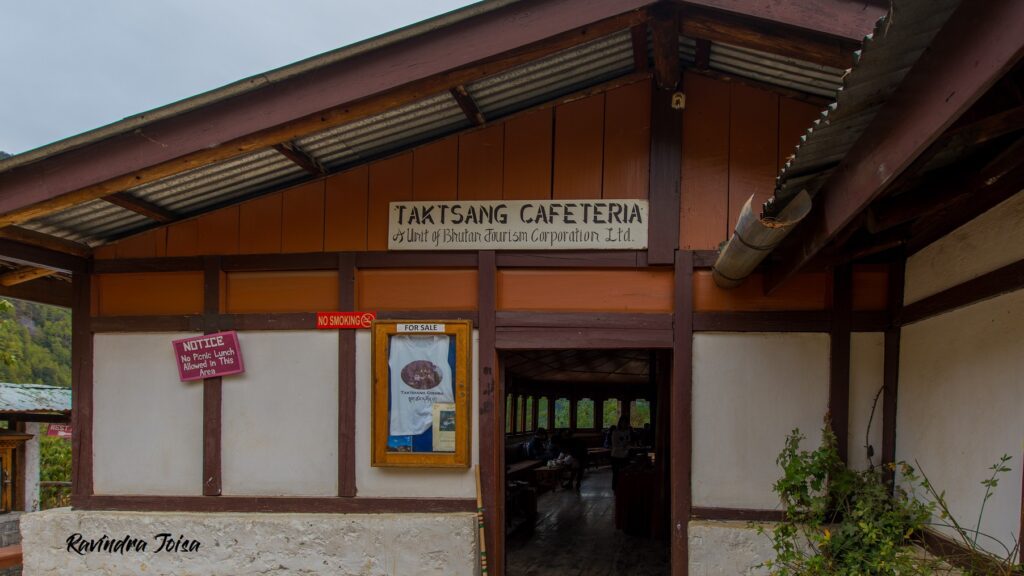
The trek to Tiger's Nest is difficult; it takes around five hours to complete a circular journey. The route ends with a flight of extremely steep stairs. About halfway up, there's a café, which is a nice area for a refreshing drink and some amazing photos. The cafe appears more like a huge treehouse from the inside and the food price is on the higher side. Restrooms and an indoor seating space are available, as well as snacks, lunch, and drinks. It's a nice spot to take a break. The monastery has its lunchtime between 12 and 1 p.m., and visitors will have to wait outside during lunchtime.
Tiger's Nest Cafe
Bridge and the waterfall
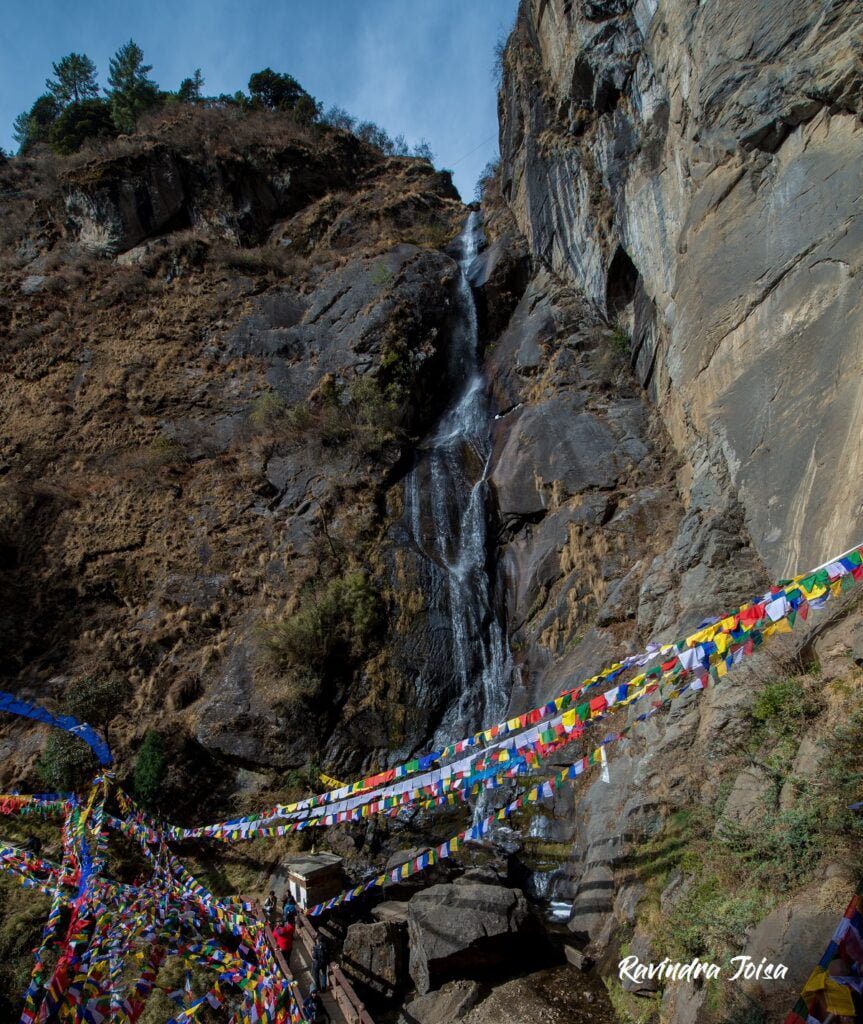
We reached a viewing platform as we rounded a bend on an unusually flat route, and there it was, the Tiger's nest, sitting magnificently across from us. Surprisingly, we were just a few feet higher than the Tiger's Nest. The view of the pine woods and valley below was really stunning. A rope bridge traverses the gap near to a waterfall, surrounded with prayer flags, farther down the route.
Bridge and the waterfall at Tiger's Nest
You must trek a bit farther up the mountain to reach the Tiger's Nest Monastery using this path. Then you descend several hundred stairs back into the mountain, only to have to climb many more steps on the opposite side of the rope bridge to reach the top. The area surrounding the bridge is especially calm and pleasant. Prayer flags swing in the breeze, as water from the waterfall sprays into the air. It was a terrific way to re-energize and be ready for the last leg of our adventure.
What to expect inside Tiger's Nest
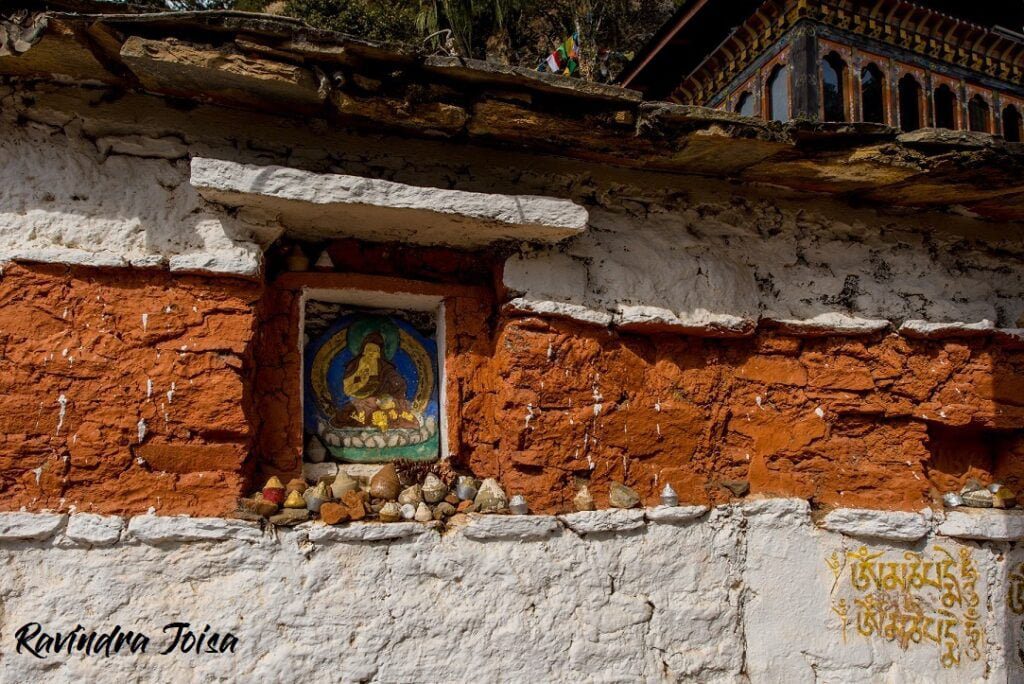
You cannot take cameras and phones and it is safe to hand over them to our local guide once you arrive at the Tiger's Nest's main gate and have left your shoes at the entry. We entered the Tiger's Nest Monastery after a final gaze over the valley. Once inside, you will find a small Buddhist monastery with its gold-plated domes, white walls, and wooden balconies. As you go further, you will see monks chanting everywhere and a room full of oil lamps, and at the end is a narrow (Tiger's) cave, hard to enter. The Bhutanese believe that simply crossing the monastery's threshold will bring you benefits, therefore many people enter with their hands in prayer.
Tiger's Nest Monastery Entrance
Prayer flags all around Tiger's Nest
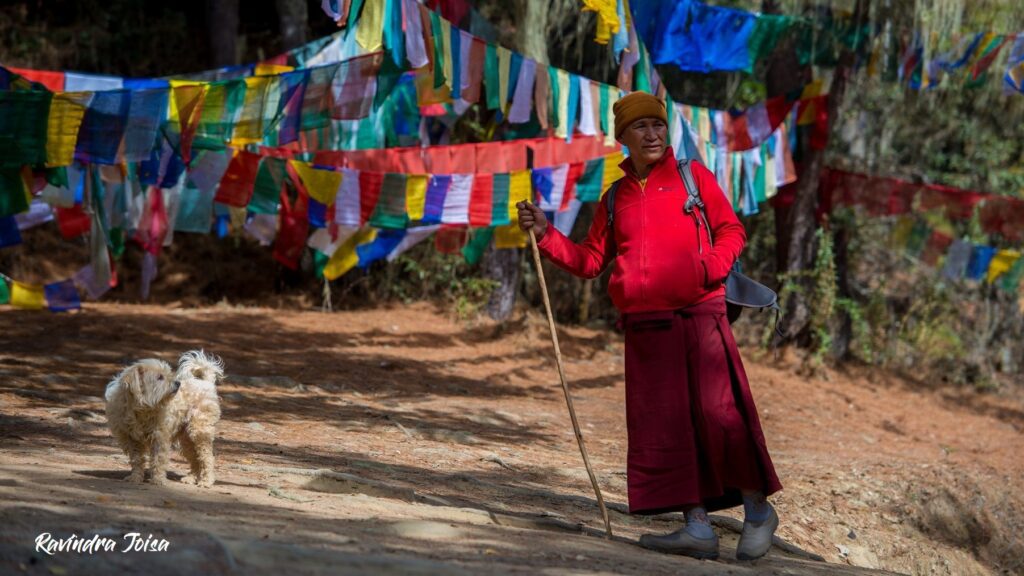
In the Himalayas, prayer flags are ubiquitous, especially along the path to Tiger's Nest. You will find prayer flags outside of residences, along mountain paths, and across bridges to represent happiness, long life, good fortune, and karmic merit. The spiritual vibrations formed by the colored cloth are claimed to be released into the air when the wind blows through them, making everybody who is touched by the breeze happy and enriched. Local gods and spirits are also appeased using prayer flags.
Monk and his dog are on the way to Tiger's Nest. Trail full of prayer flags.
Packing essentials to go to Tiger's Nest
You may visit this place throughout the year. The trail can become extremely slick in the rain, therefore it is a good practice to wear sturdy, comfortable shoes (ideally hiking boots) with strong traction and thick socks. Rain gear will also be useful, as the weather along the path may be fickle. Bring a bottle of water and some snacks to keep you hydrated on your journey.
Ravindra after completing hiking to Tiger's Nest
A visit to this incredible cultural monument is a must-do on any trip to Bhutan and is just a few minutes' drive from Paro. Watch the video below to get a feel of how the trail is. Also, support my work by subscribing to my channel, and consider joining my Friendzone.
Punakha is a tiny town in Bhutan's western province. Camping in Punakha along the banks of the Mo Chu River is a dream come true. The golden dunes and flowing water create such a stunning scene that one is left speechless. Around the river are tiny establishments where you may spend time with the locals. You may also witness the perfect Bhutanese architecture at Punakha Dzong in the twilight.
Expect folk dance and other traditional activities at the campsite. The cultural performance was enjoyable, and after dinner, a number of us went out for drinks and lingered around the campfire talking about our trip experiences until late at night. Best place to enjoy the evening and early morning sunrise. Also, an ideal place to celebrate the new year if you are an outdoor lover.
Folk Dance while camping in Punakha, Note: Face blurred for safety reasons.
While camping in Punakha, the people around play the customary Khuru game in the morning. Bhutanese Khuru is a traditional sport. It entails firing darts outside at a distance of around 20 meters. Competitors take turns throwing two darts, one after the other. Performing singing and dancing before and after the game is common. It is fun to watch and the locals are super cool to invite you. However, you need to be careful when you throw the darts.
Bhutanese Khuru is a traditional sport
Take a tour when you are camping in Punakha. This wonderful countryside campground is so nice that it is nearly human-free. Enjoying the morning walk all along the banks of the river. The riverbank is full of pebbles and the water source is from the glaciers and Himalayan mountains. The water here is quite pure, and you can see the gravels sitting on the river bottom.
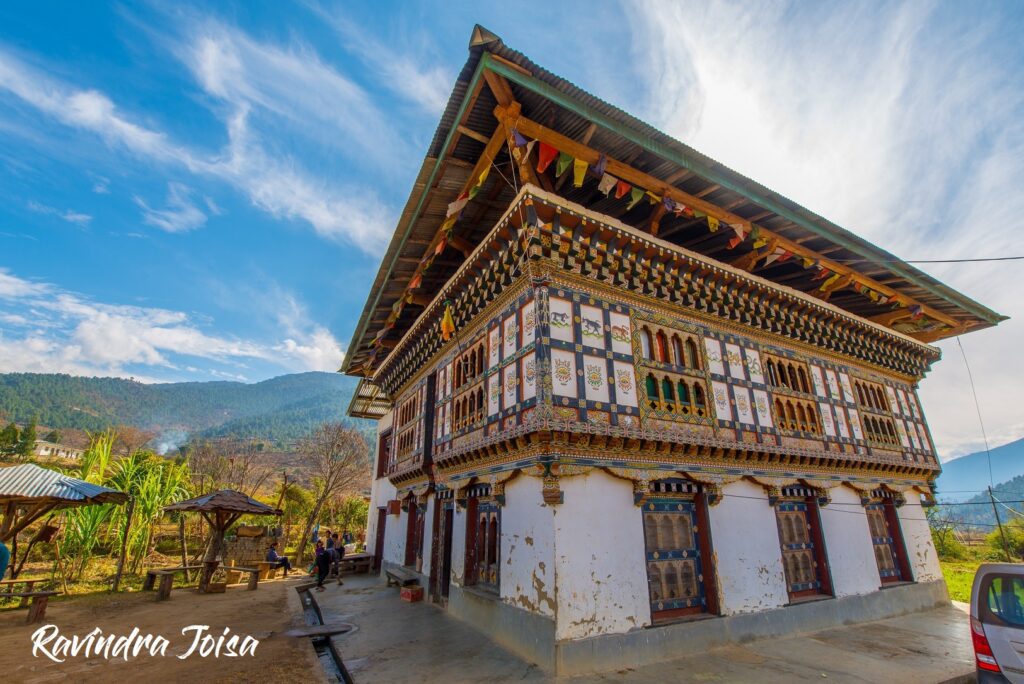
Every home in Bhutanese traditional architecture is a combination of nature and Bhutanese traditional architecture. Traditional Bhutanese architectural residences. It is a necessary regulation in Bhutan to build dwellings in accordance with traditional architecture. Even the shop names are in a single color that varies solely according to the size of the display board. A fancy colored nameplate or a display board are not permitted. The historic flour mill may be seen in the neighborhood. You may choose to speak with the locals, who will be pleased to explain in detail the material and colors that they are expected to wear, as well as their importance.
Places around if you are camping in Punakha
Punakha Mo Chu River early in the morning, view from the campsite
When you are camping in Punakha, you might want to try rafting. The place is also a good spot to try the famed Punakha river rafting. You may not find too many rapids and is ideal for beginners as it is less dangerous. The river is ideal if you are into kayaking.
Hope you enjoyed reading this blog post. Also, watch the video below to view more photos and the local folk dance and music. Moreover, support my work by SUBSCRIBING to my YouTube channel.
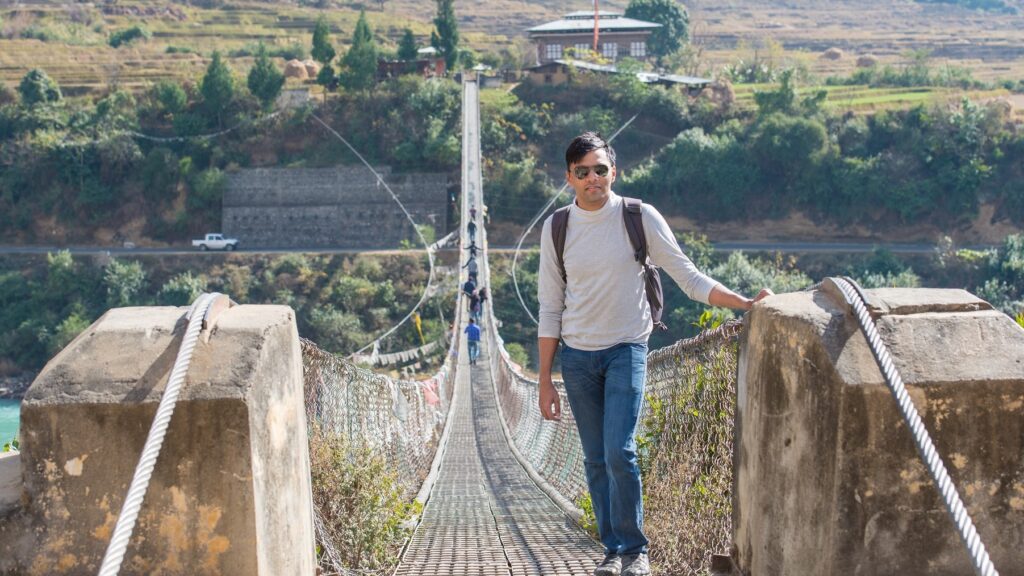
Suspension bridges are ideal for Bhutan's high mountains and deep valleys. Punakha Suspension Bridge is a wonderful illustration of this, for the decoration of colorful prayer flags. This is one of Bhutan's longest suspension bridges. It connects Punakha Dzong to Shengana, Samdingkha, and Wangkha villages across the Po Chu river. It is, nevertheless, astonishingly stable for a 520-foot-long suspension bridge. The east side of the river is an excellent starting place for multi-day hikes in the surrounding mountains. Also, the bridge provides a beautiful view of the river and valley.
Punakha Suspension bridge in Bhutan
Which is the longest bridge in Bhutan?
Punakha Suspension Bridge is one of Bhutan's longest suspension bridges, reaching 160-180m and located high over the fast Po Chhu River. The bridge links Punakha settlement and the Punakha Dzong and is mostly utilized by inhabitants from the opposite side of town as a bypass to the Punakha Dzong.
How to get there?
Punakha Bridge is a short walk from Punakha Dzong, but because it is not on the main highway, people overlook this place. Follow the Puna Tsang Chu River north from the Dzong, through the crematorium, either by country roads on the west bank or the Trashigang-Semtokha Highway. If you are at Punakha campsite which is a mile from Punakha Dzong, cross the bridge.
The Suspension Bridge
The bridge in front of Punakha Dzong is an excellent example of this. The bridge at Punakha, unlike the others, takes the support of cables anchored to enormous concrete slabs on the banks. The bridge's cantilever has some inherent elasticity that causes it to sway in high gusts, although not as much as you might anticipate. This is owing to the bridge's stabilizing cables, which taper out at both ends. The deck is constructed of solid wood planks that are nested within the bridge structure.
PunaTsangChu river
Village on the other side of the bridge
Visit the lovely village on the opposite side of the bridge. The bridge connects Shengana, Samdingkha, and Wangkha villages to the Wangchuk Kings' fortress. Apart from an exciting trek across the bridge, the bridge connects Punakha town to numerous holy and important locations worth visiting.
The best thing to do here is cross the bridge, visit the local shop and have the local tea. You get to hear the prayers, drum beats, etc from upstairs and lots many people chanting mantras. Enjoy the scenic view, have a cup of tea with the chanting mantra as your background music and then go around the prayer wheel. You can continue to explore the village further or go back to cross the bridge and visit the Punakha Dzong.
Punakha enjoys a pleasant climate throughout the year. Visit Punakha in the months of February to April and October to December. It's best to stay away from this valley during the wet seasons, as flash floods are prevalent. Every year, the Tsechu festival takes place in late February or early March, giving it the perfect opportunity to appreciate Bhutan's spring weather and culture. The spring season, with a mean temperature of 18°C, ushers in stunning purple jacaranda blooming sceneries all down the valley.
Pho Chhu Suspension Bridge Suspension Bridge
When was Punakha suspension bridge built?
Punakha Suspension Bridge in Bhutan is one of the world's oldest suspension bridges, said to have been erected by the Buddhist monk Thangtong Gyalpo. It has been refurbished several times over the years, but it was originally one of the eight bridges that served as the prototype for many of our current suspension bridges. The bridge's age is still a mystery.
To conclude, the place is unique with the walk along the longest bridge in Bhutan. The view of mountains in front and the traditional tea on the other side of the bridge makes this place interesting. Also, check the other spectacular and top 10 places to visit in Bhutan. In addition to these photos, watch the video below for more photos and to get a feel of the place in and around Punakha Suspension Bridge. Also, consider SUBSCRIBING to my YouTube channel.
Punakha Dzong - meaning 'great pleasure' or 'joy castle', is the administrative headquarters of Punakha. It is the second oldest and second largest dzong in Bhutan, and one of its most beautiful buildings. Moreover, Punakha Dzong served as the administrative headquarters until 1955.
Importance of Punakha Dzong
Punakha Dzong, located in western Bhutan, is often regarded as the country's most beautiful Dzong. In Bhutanese history, it is also the most important Dzong. The Dzong houses most of Bhutan's national treasures, and it was here that Bhutan's King, His Majesty King Jigme Khesar Namgyel Wangchuck, and his lovely bride, Bhutan's Queen Jetsun Pema, married in October 2011. The Punakha Dzong is by far Bhutan's most iconic landmark, rivaling The Tiger's Nest in Paro, so it's easy to see why it's one of the country's top three attractions, along with the Tiger Nest Monastery and Dochula Pass.
Punakha surrounded by Po Chu Mo Chu rivers
Location of Punakha Dzong
In the Punakha valley, the location of Dzong is in between the Pho Chhu (male) and Mo Chhu (female) rivers. Punakha is Bhutan's winter capital. Because Punakha Dzong is just 1,200 meters above sea level, you will not experience oxygen difficulties as you would at higher elevations such as Paro Taktsang (Tiger's Nest), making it an excellent spot to commence for beginning hikers who may experience altitude sickness in the first few days.
The significance of Punakha Dzong is that the dzong was one of the 16 dzongs erected by the Zhabdrung during his reign from 1594 to 1651 as an "embodiment of Buddhist principles." There are three docheys in the dzong (courtyards). A steep wooden draw stairway and a heavy wooden door that is locked at night are among the defensive fortifications installed in the dzong to protect it from enemy attacks. A big prayer hall was later erected after the dzong was damaged by a fire.
Punakha Dzong Architecture
Ngawang Namgyal is the mastermind behind Punakha Dzong and is Bhutan's second oldest and most magnificent Dzong. Also, It is a six-story building with a central tower situated at an average elevation of 1,200 meters against a picturesque mountainous backdrop. In addition, compacted soil, stones, and timber for doors and windows constitute the construction of the Dzong.
Six-story building with a central tower
Firstly, the Dzong was damaged by several fires and was extensively damaged as a result of the 1897 earthquake. A high wooden draw staircase and a massive wooden door are among the defensive measures that remain tall in the dzong to safeguard it from enemy attacks.
The Courtyards
Whitewashed Stupa in the first courtyard
The first courtyard houses the dzong's administrative buildings, a huge white-washed stupa, and a bodhi tree. The monks' living quarters are in the second courtyard. In this courtyard, there are two ancient halls. Also, the burials of Pema Lingpa and Ngawang Namgyal are in the third courtyard. It is located at the dzong's southern extremity.
Bodhi Tree in the first courtyard of Punakha Dzong
In the Mo Chu and Pho Chu rivers, flash floods generated by glacial lake outburst flooding in the upper parts of the valley are regular and have caused flooding and damage to the dzong in the past. Restoration is now complete with the Government of India sponsorship. The Dzong is now as magnificent as its historic times.
Inner Courtyard of Punakha Dzong
Festivals at Punakha Dzong
Domche is a yearly celebration held at the Dzong that attracts people from all around the region, including villages and outlying areas. There are some pretty magnificent performances during this five-day celebration, also known as the Punakha festival, which takes place in February/March. A re-enactment of the Tibetan invasion of Bhutan in 1639, in which the Tibetans were defeated, is a significant exhibit. Another annual rite at this dzong is the Lhenkey Dungchhur, which is a remembrance of departed spirits.
To conclude, the place has some amazing artwork, well-documented history and attracts a lot of visitors. In addition to these photos, watch the video below for more photos and to get a feel of the place in and around Punakha Dzong. Also, consider SUBSCRIBING to my YouTube channel.